



Active Shooter Alarm Systems in Schools: Safety for Students and Teachers
Measuring Loudspeaker Impedance: Fundamentals and Practical Applications
Active Shooter Alarm Systems in Schools: Safety for Students and Teachers
Measuring Loudspeaker Impedance: Fundamentals and Practical Applications
What is speaker efficiency?
Speaker efficiency is one of the most important key figures in audio technology. It indicates how efficiently a speaker converts electrical energy into acoustic energy. In other words: how loud a speaker actually is at a given power. This value plays a decisive role, especially in sound reinforcement and PA technology, as it determines not only sound quality, but also energy efficiency and the number of speakers required.
Definition: speaker efficiency
The efficiency of a speaker is usually specified in decibels (dB). It describes the sound pressure level generated by the speaker at a power of 1 watt and at a distance of 1 metre. This measurement is often also referred to as sensitivity or efficiency.
Difference between efficiency and sensitivity
The terms efficiency and sensitivity are often used synonymously, but strictly speaking there are differences. Efficiency is a physical value that indicates what percentage of the supplied energy is converted into sound (typically only 0.5 to 5%). Sensitivity describes the sound pressure level actually measured under standard conditions. In practice, planners and users usually refer to sensitivity.
Why is speaker efficiency so important?
Efficiency largely determines how much amplifier power is required to achieve the desired volume. A difference of just 3 dB already means that twice as much or half as much amplifier power is required. In practice, high efficiency means lower energy consumption and lower costs. Especially in large buildings or systems with many speakers, the differences add up. The key advantages are:
Importance in PA and voice alarm systems
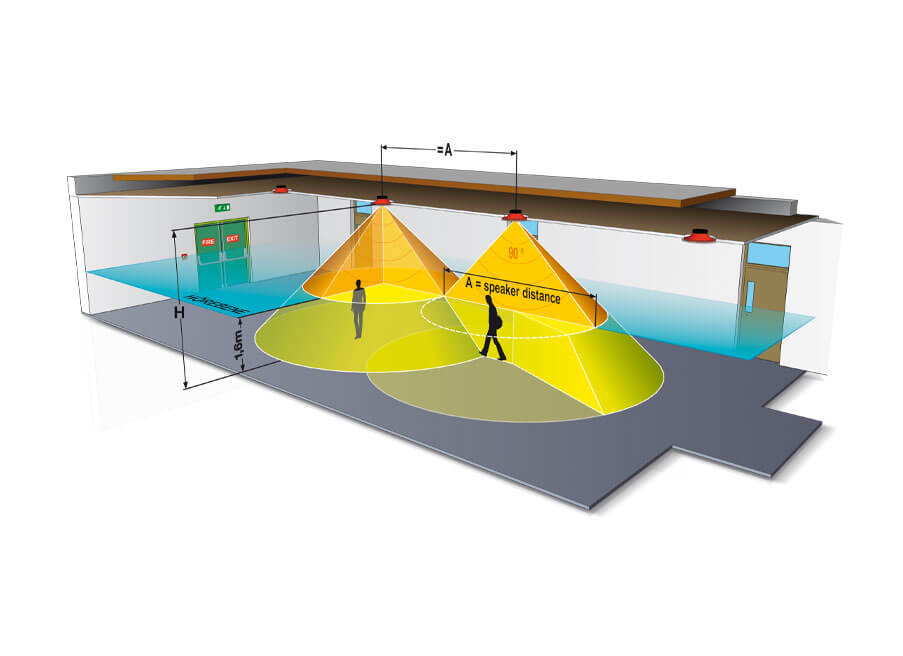
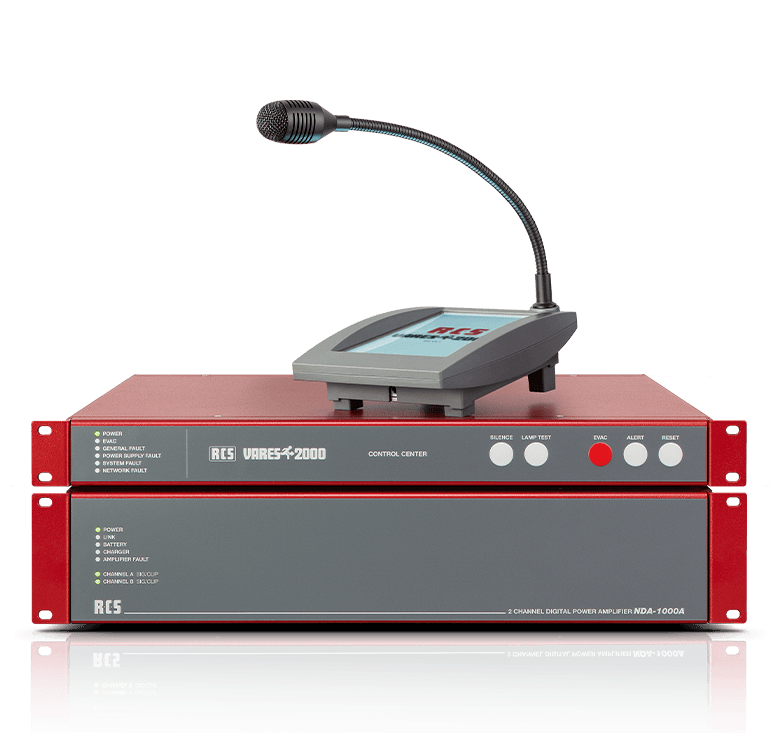
In the field of public address systems (PA) and voice alarm systems (VAS), efficiency is particularly important. Here, the focus is primarily on intelligibility and range with the lowest possible energy consumption. A speaker with higher efficiency makes it possible to provide reliable sound reinforcement over a larger area with less amplifier power.
Example: If a system is installed in an office building, the difference between a speaker with 85 dB and one with 91 dB efficiency may already mean that a smaller, more cost-effective solution is sufficient instead of a large amplifier, while maintaining the same intelligibility.
Factors influencing efficiency
Speaker efficiency depends on various technical and physical factors:
Efficiency and room acoustics
Efficiency is a fixed speaker characteristic, but the listening result depends heavily on the room acoustics. In hall-like rooms with a lot of reverberation, part of the energy is lost, while in acoustically optimised environments the full efficiency can be used. That is why it is important to always consider speakers, amplifier power and room conditions in context.
Misconceptions about efficiency
Many users automatically associate high wattage ratings with high volume. In reality, wattage only indicates the possible power handling; the decisive factor for perceived volume is efficiency. A speaker with low power but high efficiency can in practice be significantly louder and clearer than a “more powerful” model with poor efficiency.
Conclusion
Speaker efficiency is a decisive factor for every sound reinforcement or alarm notification system. It influences not only volume, but also efficiency, costs and planning reliability. Anyone planning professional PA or voice alarm systems should therefore choose speakers with suitable and preferably high efficiency. This is the only way to optimally combine speech intelligibility, cost-effectiveness and operational reliability.